
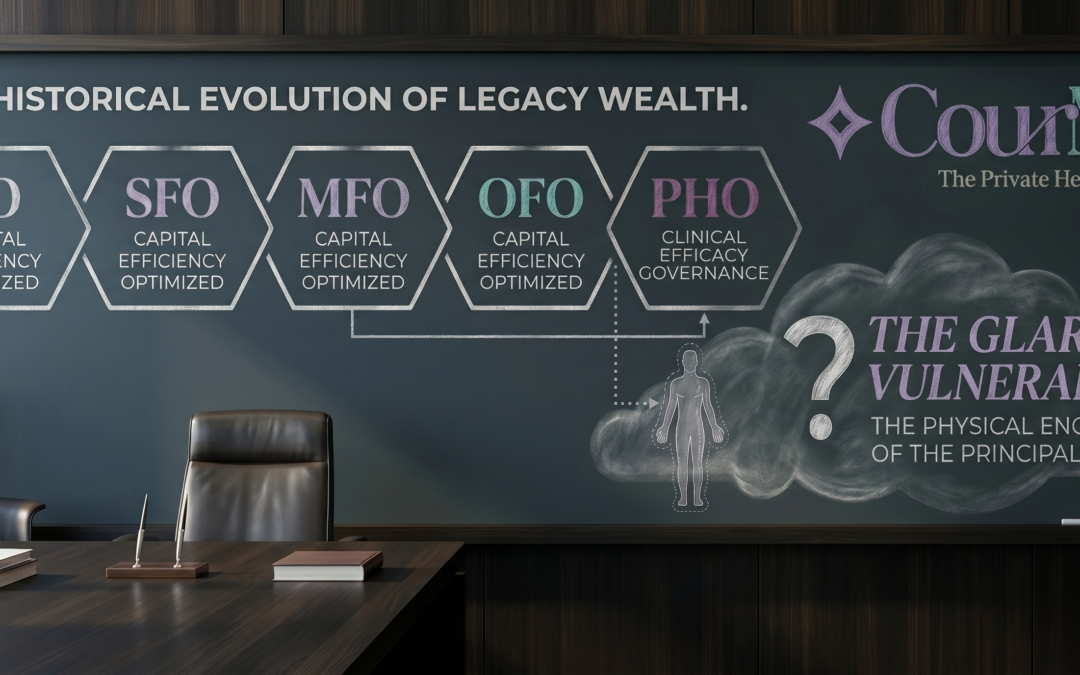
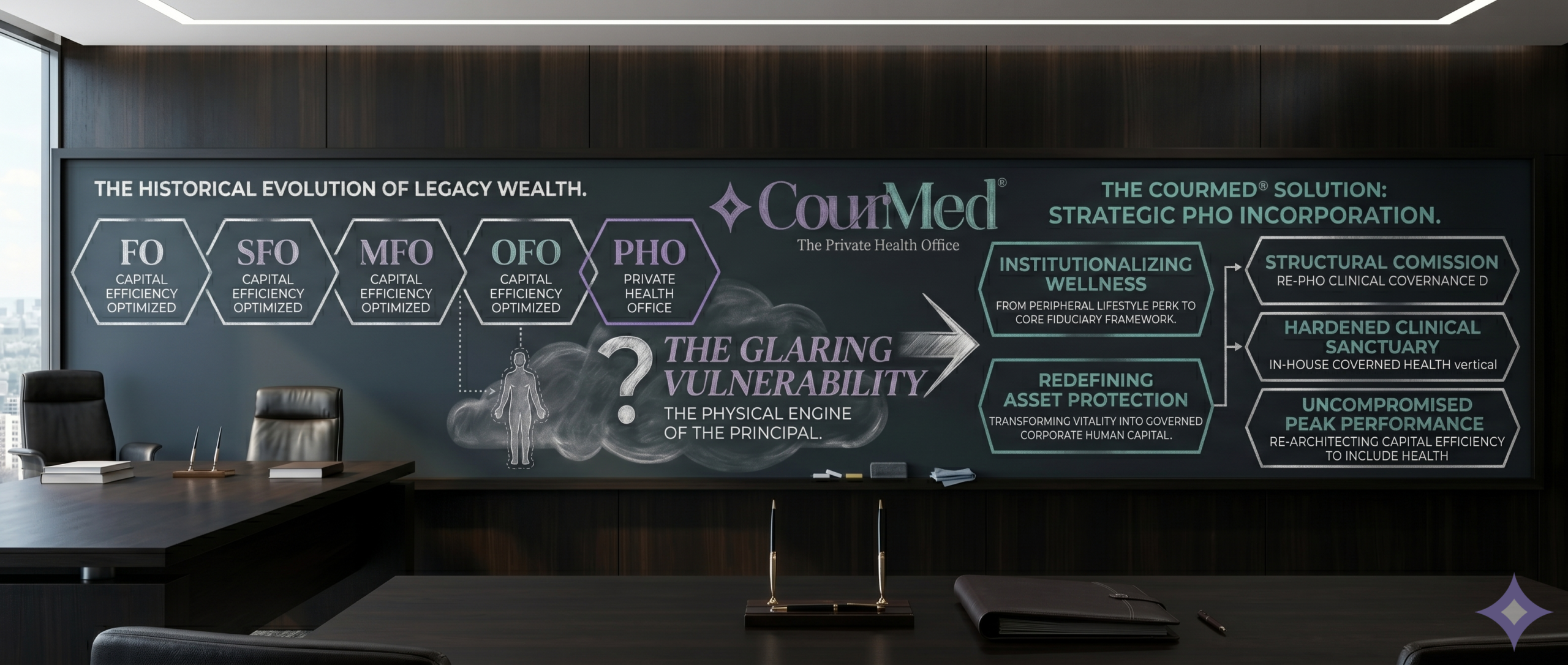
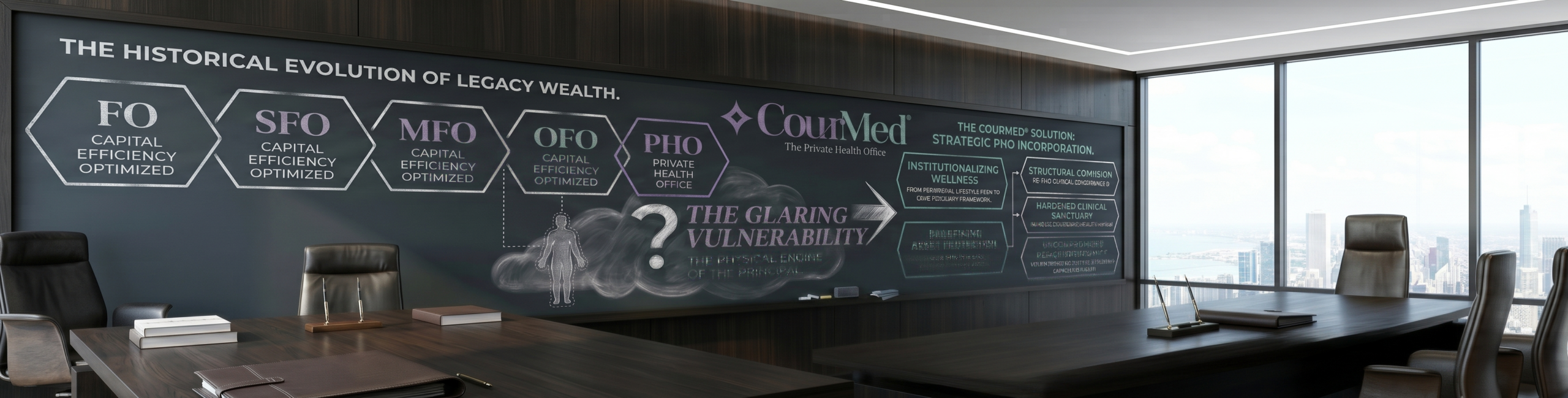
The structural trajectory of ultra-high-net-worth (UHNW) wealth management has historically evolved to solve for asset protection, tax mitigation, and capital efficiency. This progression moved from basic Family Offices (FO) to Single-Family Offices (SFO), Multi-Family Offices (MFO), and eventually Outsourced Family Offices (OFO).
While these ecosystems possess institutional-grade sophistication in managing financial asset classes, they have historically left a glaring vulnerability unmanaged: the physical engine of the principal—the ultimate fiduciary asset driving the entire enterprise.
This briefing introduces the Private Health Office (PHO), a structural framework developed by CourMed® to solve this systemic omission by dismantling the temporary “Tent” dynamics of retail healthcare and replacing them with an institutional “Fortress” of clinical governance embedded directly into the legacy infrastructure.
The Systemic Omission: A Unhedged Fiduciary Risk
A sophisticated single-family office allocates millions to build an unassailable financial and operational Fortress—securing trophy properties with hardened physical perimeters and engineering multi-layered cybersecurity firewalls to protect data assets. Yet, when mitigating the operational exposure of the primary wealth creator’s health, the strategy consistently defaults to a fragmented, highly vulnerable Tent.
This Tent consists of reactive, retail concierge doctor networks, transactional medical navigators, and disjointed lifestyle apps. It is a temporary shelter, easily collapsed by a sudden health deficit or regulatory exposure. If an estate’s continuity plan relies entirely on the principal’s real-time decision-making, but the clinical strategy is housed in a retail Tent that only activates at the point of crisis, the entire multi-generational infrastructure is fundamentally compromised.
The Solution: Institutionalizing the Private Health Office (PHO) Fortress
The PHO structure treats health maintenance with the exact same fiduciary weight as legal counsel, cybersecurity frameworks, or portfolio stop-losses. It moves health optimization off personal expense reports (the hallmark of a lifestyle Tent) and places it securely within the corporate architecture as an operational Fortress under “Operational Risk & Corporate Continuity.”
Through a disciplined Risk Insulation model, the PHO Fortress enables family offices to deploy proactive, continuous wellness strategies internally while routing all clinical data layers and malpractice liabilities through licensed, specialized third-party entities. This clear demarcation establishes an ironclad clinical governance firewall—shielding the core holding company from the regulatory, HIPAA, and liability exposures that inherently plague uninsulated retail Tents.
Conclusion
As functional medicine, longevity protocols, and biometric tracking become the standard operating procedure for global legacies, wealth management can no longer limit its scope to financial markets, nor can it outsource human capital defense to flimsy retail operators. Legacies cannot be sustained from a temporary Tent. The future of wealth management requires building a sophisticated Fortress that masters the time horizon of its most critical asset.