
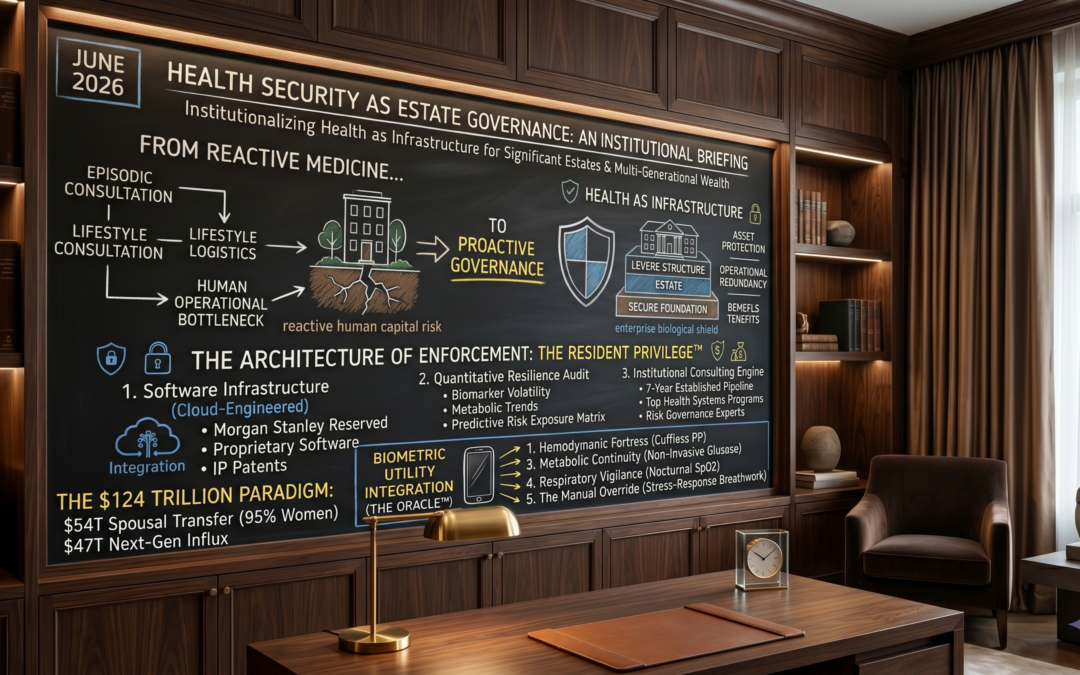
Institutionalizing Health as Infrastructure for Significant Estates and Multi-Generational Wealth
Author: Courtney Cohen, Director of Estate Governance
Organization: CourMed®
Date: June 2026
Classification: Institutional Briefing for Significant Estates, Multi-Generational Family Offices, Trustees, and Legacy Allocators
I. Executive Summary: The Biological Black Swan
Modern wealth preservation is engineered with absolute structural defense. Significant estates, multi-generational family offices, trustees, and estate attorneys spend generations building sophisticated legal, financial, and technological fortresses. Multi-generational capital is shielded through asset protection trusts, sovereign corporate structures, predictive market algorithms, and ironclad cybersecurity protocols.
Yet, the primary asset underpinning the entire architecture—the physical capacity of the estate principal and the core lineage—is consistently left entirely exposed to systemic vulnerability.
Historically, family offices have treated principal health as a personal, lifestyle, or consumer-level concern. When a crisis occurs, the estate enters a highly reactive state, leaving the continuity of the entire enterprise vulnerable to sudden, unpredictable human capital risk. This systemic blind spot operates as a hidden, volatile tax on decision-making, executive performance, and multi-generational succession.
This white paper defines a critical paradigm shift: the transition from reactive, episodic medical management to Health Security as Estate Governance. By implementing an invisible, tech-enabled enterprise utility layer, significant estates can establish Health as Infrastructure—treating their physical foundation with the exact same architectural rigor, capital allocation, and risk engineering applied to a global investment portfolio or physical asset class across multiple generations.

II. The Evolution of Private Wealth Health Management
As the complexities of managing multi-generational wealth expand, legacy medical paradigms face structural limitations when trying to align with the rigorous operational demands of a modern single-family office. To properly transition to an asset-protection framework, family office CIOs and trustees must evaluate health management through an institutional lens:
- The Human Operational Bottleneck: Traditional medical consultation frameworks are fundamentally tethered to unscalable human hours. When a complex health event or dynamic diagnosis arises, manual coordination relies on ad-hoc communication networks and individual provider availability. For significant estates, reactive navigation cannot match the non-linear, time-sensitive demands of true leadership continuity.
- The Shift Beyond Lifestyle Logistics: Standard private medical offerings often focus on lifestyle logistics—coordinating executive physicals, managing travel medicine, or addressing localized health events. While useful for personal convenience, these services lack the enterprise engineering required to algorithmically monitor baseline volatility, analyze systemic biological risk exposure, or actively enforce preventative protocols at scale for a complex family tree.
- The Demand for Absolute Data Sovereignty: Traditional clinical touchpoints pull the principal into external, high-friction healthcare environments where data privacy can become fractured across fragmented institutional databases. For significant estates, absolute discretion is a structural necessity. Protecting the lineage requires an unassailable framework that isolates health intelligence from public bureaucracies, ensuring total privacy.
III. The Macro Wealth Shift: The $124 Trillion Paradigm
The urgency to institutionalize health security is driven by an unprecedented demographic realignment. The United States is currently undergoing a $124 trillion transfer of wealth, structurally altering the priorities of the family office ecosystem:
- The $54 Trillion Spousal Transfer: Approximately $54 trillion of this capital is transferring directly to surviving spouses, 95% of whom are women.
- The Next-Gen Influx: An additional $47 trillion is flowing down to the next generation of legacy stewards.
Data from recent family office wealth studies makes the operational reality clear: the emerging stewards of significant global wealth are entirely redefining their relationship with health management. Surviving spouses and next-generation principals expect highly integrated, low-friction systems that match the tech-enabled, frictionless environments they use to manage their broader assets.
They demand an institutional environment where their asset protection requirements are the baseline assumption, not the exception. They require a discreet, high-integrity framework that integrates health security directly into existing estate mandates, prioritizing preventative data security, sovereign autonomy, and operational redundancy.
IV. The Architecture of Enforcement: The Resident Privilege
To transcend the labor dependencies of traditional consultation, a significant estate must deploy an automated, technological infrastructure layer designed to enforce biological stability. Within the CourMed enterprise platform, this architecture of enforcement is executed natively as The Resident Privilege.
The Resident Privilege™ treats the lineage’s physical foundation as a sovereign asset class. Rather than relying on manual, ad-hoc doctor coordination, the framework enforces protection through a synchronized, enterprise utility layer:
1. Cloud-Engineered Software Infrastructure
The framework operates on a proprietary software architecture backed by multiple intellectual property patents and validated through deep integration with institutional partners, including the Morgan Stanley Reserved platform. This secure digital infrastructure layer unifies biometric data monitoring, predictive risk profiling, and immediate care deployment into a single, closed-loop sovereign system. Data is completely decoupled from public medical networks, protecting the privacy and security of the estate.
2. The Quantitative Resilience Audit
Rather than waiting for late-stage diagnostics, The Resident Privilege continuously quantifies human capital risk. Through automated data aggregation, the system actively monitors and analyzes biomarker volatility, metabolic trend lines, and cognitive performance indicators to map out an active risk exposure matrix. Potential vulnerabilities are caught and neutralized at the algorithmic level, months before manifesting as an operational emergency.
3. The Institutional Consulting Engine
To maintain unshakeable operational continuity, the delivery platform is governed by a permanent, continuous pipeline of trained health administration professionals. Utilizing a 7-year established pipeline with the nation’s top-ranked health systems management programs, CourMed deploys dedicated consultants who understand macro risk governance, legal compliance, and estate integration. The business model is entirely insulated from individual provider dependencies; if a specific clinician rotates out, the technological and operational infrastructure layer continues uninterrupted.

V. Biometric Utility Integration Case Study: The Preventative Endpoint via The Oracle
A primary execution vector of The Resident Privilege is its ability to seamlessly absorb and maximize breakthrough biological assets. Under the CourMed® architecture, advanced monitoring technology is elevated beyond a retail device and re-engineered as a preventative, continuous biometric utility—personified by The Oracle—which plugs directly into the sovereign enterprise software platform.
Presented as an elegant, screenless, slender adornment, The Oracle™ operates as an invisible infrastructure layer. It integrates five clinical-grade modules into a unified shield, continuously streaming encrypted biometric telemetry into the estate’s secure utility infrastructure to enforce biological stability across five core pillars:
- 1. The Hemodynamic Fortress (Cuffless BP): Leveraging next-generation photoplethysmography (PPG) sensors, The Oracle provides continuous blood pressure monitoring without the friction of an inflatable cuff. The enterprise system actively monitors for Nocturnal Non-Dipping—a silent, nighttime elevation in blood pressure that serves as the primary predictor of sudden stroke and cardiovascular failure, neutralizing vascular risk before it manifests clinically.
- 2. Metabolic Continuity (Non-Invasive Glucose): The system introduces non-invasive, needle-free glucose oversight through transdermal and breath-based acetone analysis. By governing Glycemic Variability in real-time, it protects the vascular lining and prevents the metabolic drops that can accelerate long-term cognitive and neurological decline.
- 3. The Autonomic Compass (Clinical HRV): Utilizing Heart Rate Variability as the definitive metric for autonomic nervous system resilience, the platform identifies a sustained drop in HRV up to 72 hours before a systemic inflammatory event or acute immune crisis occurs. This early window allows the Private Health Office to deploy preventative, proactive recovery protocols well ahead of symptoms.
- 4. Respiratory Vigilance (Nocturnal SpO2): By analyzing Pulse Wave Velocity (PWV) and respiratory trends, the utility identifies Silent Hypoxia—a sudden drop in nighttime oxygen saturation that places immense strain on the myocardium. This continuous oversight actively defends the principal against nocturnal cardiac events and sleep-apnea-induced crises.
- 5. The Manual Override (Stress-Response Breathwork): When the utility identifies an acute, sympathetic “Stress Storm” via precise inhale-to-exhale ratios, the platform closes the loop. Rather than delivering an alarmist notification, it triggers an immediate Biofeedback Loop—guiding the Principal through clinical breathwork to instantly down-regulate cortisol production and protect the heart from stress-induced cardiomyopathy.
By treating these data streams not as episodic medical checks but as a continuous biometric utility, the system monitors data inputs against strict institutional benchmarks. This unified approach transforms a sophisticated biometric utility into an active asset-protection tool, giving institutional allocators and single-family offices a turnkey, highly scalable model for protecting principal longevity.
VI. Conclusion: Enforcing the Sovereign Future
The concept of health governance requires more than shifting marketing terminology; it requires a fundamental evolution in operational plumbing, scalability, and technological infrastructure. True luxury is not defined by navigating a medical crisis after it arrives; it is defined by building the infrastructure necessary to prevent the crisis from occurring.
The Resident Privilege stands alone as the validated framework capable of converting health security into an active arm of estate governance for significant estates over multi-generational wealth. By treating Health as Infrastructure with the same institutional rigor as financial wealth, CourMed ensures that multi-generational estates remain sovereign, resilient, and unassailable against biological black swan events. The future of legacy preservation belongs to those who govern their health security as an institutional asset.