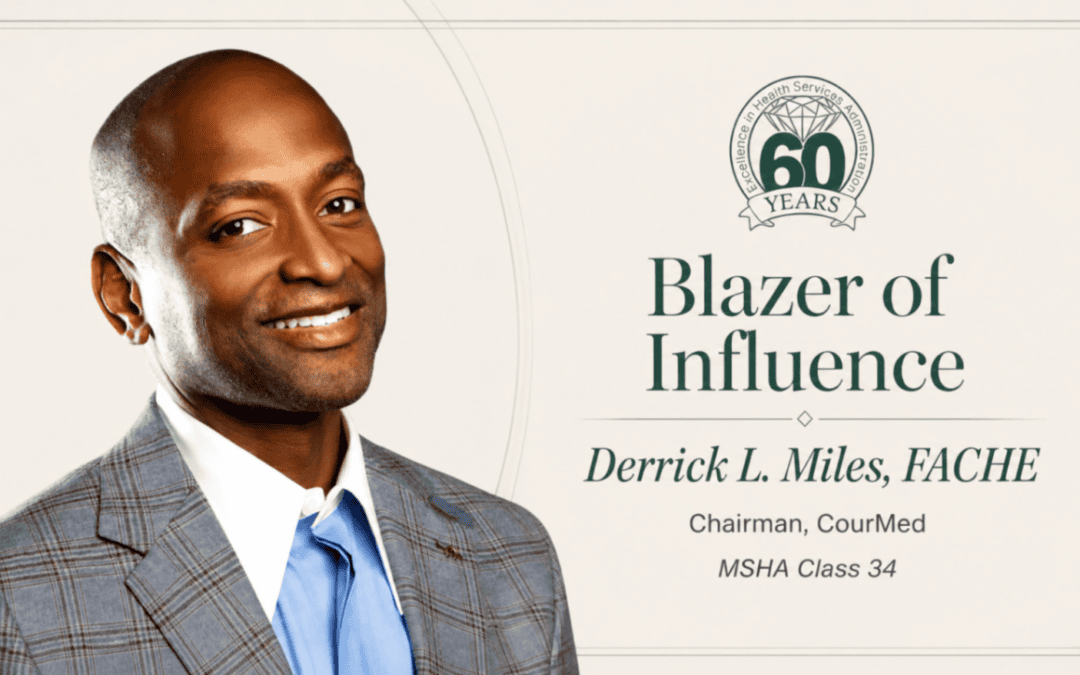
CourMed® is pleased to celebrate Derrick L. Miles, MSHA, FACHE, being recognized as a Blazer of Influence during the University of Alabama at Birmingham Department of Health Services Administration’s 60th Anniversary Gala.
This recognition honors more than a successful career. It reflects Miles’ continued work to improve how health is planned, delivered, and protected for families, executives, institutions, and emerging leaders.
We invite colleagues, students, clients, and collaborators to share how Derrick may have influenced their lives and careers in the comments.
A Career Built on Systematic Innovation
Derrick L. Miles is the Chairman of CourMed®, a pioneering, technology-enabled Private Health Office built for families with significant estates, family offices, private banks, corporate boards, and elite private enclaves.
His career spans more than two decades of systematic innovation in health administration, operations, technology, and executive leadership. As an inventor-operator holding multiple patents, Miles has commercialized advanced intellectual property and scaled an enterprise platform supported by institutional technology leaders, including Google and Microsoft.
His work is grounded in a straightforward question:
What would change if a principal’s health received the same level of planning, oversight, and discretion as the family’s financial affairs?
The answer is CourMed’s Private Health Office model.
A Private Health Office, or PHO, functions as a dedicated health-security layer for the family. It helps coordinate clinical practitioners, proactive health support, advanced diagnostics, continuity planning, and longevity programs across the places where a family leader lives, works, and travels.
This is not a reactive service that waits for a crisis. It is a structured approach to protecting the health, capacity, and continuity of the people responsible for leading families, companies, and institutions.
From Reactive Care to Proactive Health Security
For many families, health support remains reactive, bureaucratic, and fractured. Information is spread across different providers. Follow-up can depend on memory. Important decisions may be delayed until symptoms become impossible to ignore.
That approach may be acceptable for ordinary circumstances. It is not sufficient for a family leader whose judgment, energy, and availability affect employees, investments, philanthropic commitments, and future generations.
CourMed does not provide concierge medicine. Its Private Health Office is a superior service that coordinates clinical practitioners and proactive health support in the home, office, and gateway cities during global pursuits.
The difference is meaningful.
CourMed is designed to give principals and their trusted advisors a clearer view of health priorities before they become disruptions. The service can support:
- Health planning across residences, offices, and international travel
- Coordination with appropriate clinical practitioners
- Early-warning diagnostics and proactive testing
- Cognitive and physical vitality programs
- Longevity support built around evidence-based clinical care
- Continuity planning when a principal is moving between locations
- Discreet communication and reduced administrative friction
This is the foundation of health as a fiduciary asset. The phrase does not turn a person into a balance-sheet item. It recognizes a simple reality: a family’s health affects its ability to make decisions, protect relationships, lead enterprises, and carry a legacy forward.

Health as a Fiduciary Asset
Miles’ perspective on “Health as a Fiduciary Asset” has received visibility in publications and platforms including Crain Currency, CNBC, and Impact Wealth Magazine.
The idea is especially relevant for multi-generational families.
A family office may maintain detailed plans for investments, tax matters, property, cybersecurity, succession, and philanthropy. Yet the health of the principal and other key family leaders can remain outside the same planning structure.
That creates an avoidable gap.
A sudden health event, prolonged burnout, or loss of executive capacity can affect far more than one individual. It can place pressure on family relationships, business operations, board responsibilities, and succession plans.
Health security closes that gap through proactive planning and seamless coordination.
CourMed’s approach is outlined further in The Fiduciary Responsibility of Health as Infrastructure, which explains why health should be treated as a core part of long-term family and leadership planning.
The goal is not to create more complexity. The goal is to make important support easier to access, easier to coordinate, and more consistent across the principal’s life.
Building the Private Health Office Utility Layer
Miles describes CourMed as a Private Health Office utility layer engineered on advanced cloud infrastructure.
In simple terms, the platform helps organize the people, services, information, and workflows required to support health security at a high level.
The technology is important, but it is not the entire value. The real value is the combination of technology, clinical coordination, discretion, and operating discipline.
A luxury timepiece is not valuable only because it tells time. A Formula 1 team is not defined only by the speed of its car. The value comes from precision, preparation, timing, and the ability to perform without unnecessary friction.
Why should a family’s health infrastructure be managed with less care?
CourMed applies this same standard to the health needs of principals and their families. The model is designed to support uninterrupted momentum while protecting privacy and reducing the burden placed on the principal, family office staff, and executive assistants.
This is the thinking behind The Resident Privilege: private health support integrated into the places where clients already live and operate.

Developing the Next Generation of Health Security Advisors
Miles’ influence extends beyond technology and service design. He is also investing in the future leadership of health administration.
For seven continuous years, CourMed has collaborated with undergraduate Health Administration students. Students intern with CourMed as Management Consultants every semester, gaining direct exposure to the strategy, operations, technology, and leadership questions shaping the next generation of health services.
This is more than a traditional internship.
Students learn how health administration operates beyond a single hospital or health system. They see how family offices, private institutions, technology platforms, clinical practitioners, and executive leaders must work together to manage complex health needs.
Through this hands-on experience, students develop:
- Corporate strategy skills
- A working understanding of health technology
- Operational foresight
- Clear communication with executive stakeholders
- An understanding of human capital risk
- The ability to connect clinical support with long-term planning
- The judgment required to work with discretion and professionalism
Miles refers to the emerging leaders in this field as Health Security Advisors. Their role is to help families and institutions understand health risk before it becomes a major disruption.
The need for this kind of leadership is growing. Family offices are increasingly expected to support not only wealth preservation, but also the well-being, continuity, and resilience of the people behind that wealth.
The next generation of health executives must be prepared to think across disciplines. They must understand clinical care, technology, operations, family dynamics, executive performance, and legacy planning.
CourMed gives students a place to build that understanding through real work.
A Blazer of Influence for a New Era
Derrick L. Miles’ recognition as a Blazer of Influence is closely connected to the values of the UAB Department of Health Services Administration: leadership, innovation, service, and the development of capable health executives.
As a proud UAB alumnus, Miles has continued to support the next generation of leaders through mentorship, student collaboration, and educational initiatives. His earlier support for the TMB Equity Partners Endowed Scholarship in Health Administration reflects the same commitment to expanding opportunity and encouraging students to view health administration broadly.
His career shows what can happen when a health executive looks beyond established systems and asks better questions.
Can technology reduce friction without reducing human judgment?
Can clinical support be coordinated around the life of the principal rather than forcing the principal to manage a fractured system?
Can health planning become a standard part of family office strategy?
Can emerging leaders be prepared to govern health risk with the same discipline expected in finance, operations, and law?
Miles’ work answers yes.

The CourMed Standard
CourMed represents a clear shift in how significant families can approach health.
The old model is reactive, fragmented, and difficult to navigate. The CourMed model is tech-enabled, seamless, discreet, and predictive.
It is built for principals who value absolute peace of mind. It is designed for family office directors who need dependable coordination. It supports corporate boards that understand the effect of executive health on continuity. It gives emerging leaders a practical view of where health administration is going next.
Derrick L. Miles’ Blazer of Influence recognition celebrates a career that continues to redefine the boundaries of health delivery, technology-enabled infrastructure, operational scaling, and elite talent development.
For families building a legacy across generations, the message is direct:
Protecting the family begins with protecting the people who lead it.
Learn more about CourMed’s Private Health Office model at CourMed.com or request a private briefing. For additional perspective, read The Health Files Family Offices Often Overlook and learn more about the UAB Department of Health Services Administration.